7 June 2026 · 9 min
This article is part of our work in industrial and naval photography. Most people never see this. A giant ship, lifted out of the water, fully exposed, resting on blocks at the bottom of a dry dock. It's one of the most striking images in the shipping industry — and one of the least known outside the shipyard. It's also one of the most demanding subjects in industrial and naval photography, and one I've learnt to capture over nine years of exclusive photographic work at the Lisnave shipyard in Setúbal. Before the photographic narrative, it's worth explaining what is actually happening — technically — every time a ship enters a dry dock.
A graving dock is a concrete basin built at the water's edge with a sealed entrance gate. The operating principle is straightforward but the engineering is not: the ship is floated in at high water with the gate open, positioned precisely over a pre-arranged set of keel blocks — concrete or timber supports that will take the full weight of the vessel once the water is gone — and the gate is closed behind it. High-capacity pumps then begin evacuating the water from the basin. As the level drops, the ship settles progressively onto the keel blocks, which are aligned with the ship's keel line to distribute the load safely. Once the dock is dry, the hull sits completely clear of the water and every underwater surface — hull plating, propeller, rudder, sea-chests, sacrificial anodes — is fully accessible. When the work is complete, the process reverses: the dock is flooded by gravity or by pump, the ship refloats, the gate opens and the vessel is towed or sailed out. The entire cycle is managed by the shipyard's docking master, whose responsibility is to make sure the ship never touches the blocks in the wrong sequence or the wrong place.
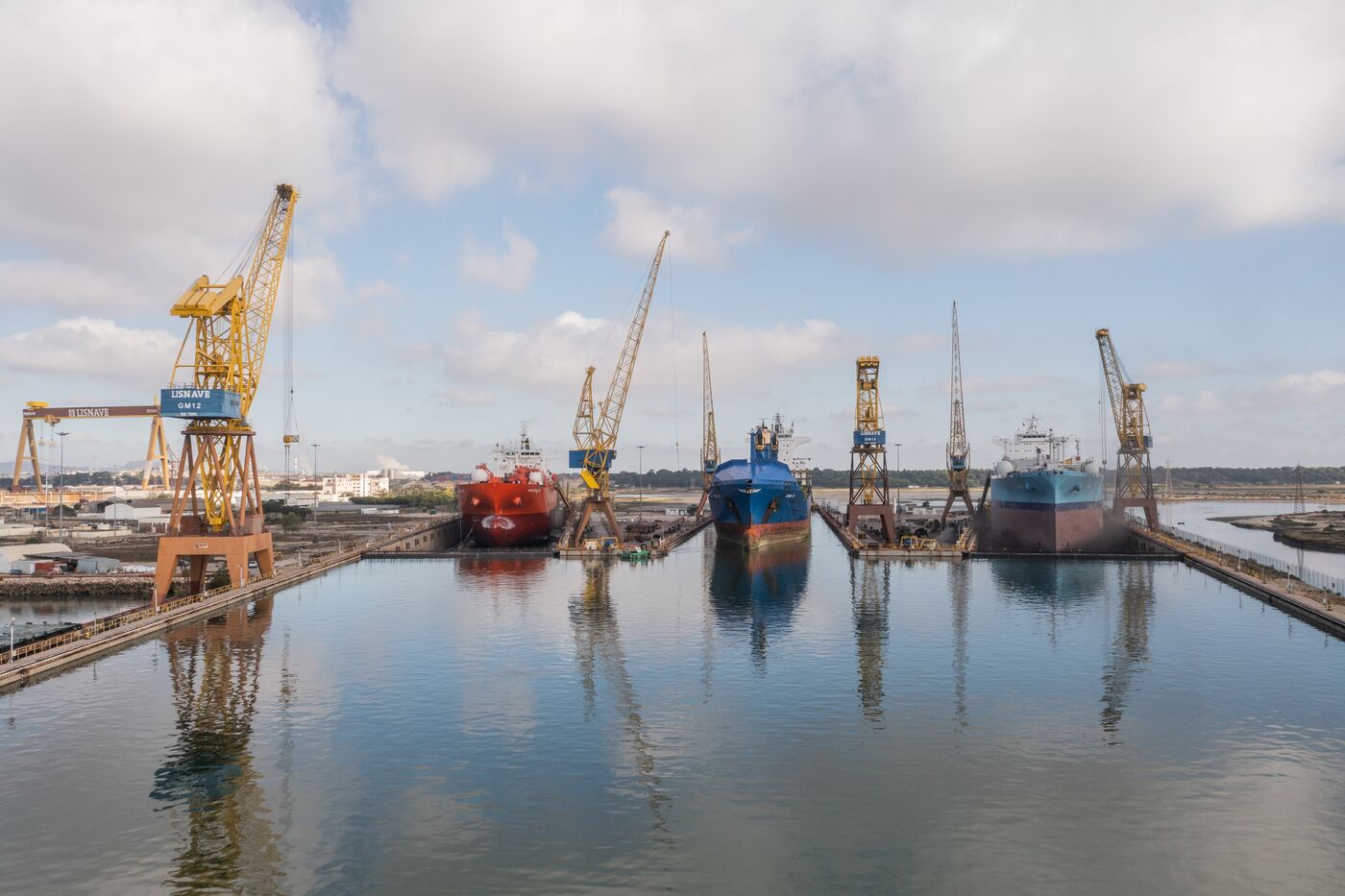
Lisnave's yard at Mitrena, in Setúbal, operates six dry docks — a capacity that makes it one of the largest ship repair facilities in Europe. Three of them are traditional large-format graving docks capable of receiving VLCCs (Very Large Crude Carriers), the biggest class of crude-oil tankers afloat. The other three are part of a system called Hydrolift, completed in October 2000 and designed by Portuguese engineers. The Hydrolift docks measure 280 metres in length and 39 metres in width each, placing them firmly in the Panamax class — the maximum size that can transit the original Panama Canal locks. What makes the Hydrolift unconventional is the docking mechanism itself: instead of being excavated below ground level like a traditional graving dock, these basins sit at platform level. A frontal lock structure raises the ship up to working-platform height on entry, and reverses the process on departure. The system was inaugurated with the entry of a Norwegian vessel and has been in continuous operation since. For a photographer, the Hydrolift docks produce a completely different visual vocabulary from the traditional ones — the ship at eye level rather than below grade, the surrounding industrial infrastructure at a different scale relative to the hull.
A dry-docking follows a sequence of phases that rarely varies, though the duration and intensity of each phase depends on the vessel and the scope of work. Entry and positioning is the most choreographed moment: tugs manoeuvre the ship through the dock entrance with centimetres to spare, and the docking master verifies that the hull is aligned with the keel blocks before the gate closes. Emptying takes several hours for a large vessel — a VLCC dock holds tens of thousands of cubic metres of water. Hull exposure is when the shipyard's commercial and technical teams get their first direct look at the underwater condition of the ship: marine growth, corrosion, damage, coating condition. This is also the moment when the scope of work is confirmed or revised. The work phases overlap: hydroblasting and grit-blasting to remove the old coating and biological fouling, steel repairs and structural work where the hull requires it, machinery interventions on propeller, shaft, rudder and sea-chests, anti-corrosion coating application, and finally anti-fouling paint — the last layer to go on before re-flooding. Re-flooding and undocking mirrors the entry sequence in reverse. The entire process for a standard repair docking on a Panamax-class vessel typically runs between ten and thirty days, depending on the scope; major conversions or retrofits can extend to several months.
Duration is driven by several compounding factors. The pre-docking survey determines the baseline scope, but the true picture only emerges once the hull is exposed — additional steel work, unexpected corrosion or a classification-society inspection finding can all extend the timeline. Owner requirements for efficiency upgrades, such as a bulbous-bow retrofit or a new propeller specification, add to the planned scope. Regulatory requirements from classification societies (Lloyd's, DNV, Bureau Veritas and others) impose mandatory inspection intervals and certification hold points that the shipyard schedule has to accommodate. Labour availability, supply chain lead times for steel plate and coating materials, and the number of vessels simultaneously in dock all feed into the final duration. Every idle day in dock has a contractual cost — the hire rate of a large tanker runs to tens of thousands of euros per day — which means every phase of the docking is planned and managed against the clock.
Photographic documentation of a dry-docking has concrete technical and commercial value for both the shipyard and the shipowner, and this is something I've come to understand clearly over nine years at Lisnave. For the shipyard, a structured photographic record of each phase — entry, hull exposure, defect identification, work in progress, final coating, undocking — serves as evidence of the scope of work delivered, supports the technical file for classification societies, and feeds the commercial and marketing material used to attract new contracts. A well-documented docking is a competitive asset: it demonstrates process discipline and technical capability in a way that no specification document can replicate. For the shipowner, the photographic archive is equally valuable: it provides an independent record of the vessel's condition at the time of repair, serves the insurance and claims process, and gives the technical superintendent a visual reference for future docking planning. In the broader context of the global ship repair market, where decisions are made on trust and track record, the image of a ship correctly docked, well-worked and properly floated out is worth more than it first appears — if you work in the naval industry and need a photographer with this background, see our industrial and naval photography.
This is a dry dock. The ship is brought in, the water is pumped out, and the hull is left completely exposed. For the first time, every system that normally lives underwater becomes accessible for inspection and repair. This is where it all begins.
The first big moment is the bare hull. From bow to stern the steel is on full view — including the bulbous bow, that rounded submerged shape that improves the ship's hydrodynamic efficiency. In many dockings, it's precisely the bulbous bow that gets replaced with a more efficient version.
But modern docking goes far beyond repair. Bulbous-bow retrofit, fuel-efficiency upgrades, sustainability improvements — owners are no longer just fixing ships, they're future-proofing them for ever-stricter environmental rules.
Then the work begins in earnest. Hydroblasting, coating and painting, machinery interventions — all happening simultaneously, often across more than one dock at the same time. It's a choreographed operation, with dozens of crews working against the clock, because every idle day has a cost.
In the end, the ship is ready again: hull cleaned and recoated, systems tested and certified, ready for the open sea. Water floods back into the dock, the ship floats again and sails away. To anyone outside, it looks like the same ship. To anyone who was in the dock, it's the result of weeks of high-precision industrial work.
Photographing this cycle — from the drone capturing the scale of the dock to the detail of the steel at ground level — is one of the most demanding and most fascinating jobs in industrial and naval photography. It's the anatomy of a dry dock, told in images.
Keep reading